Babájídé látúnjí
Presents
UMBERMAN
LIVE AT THE
Fitzrovia Chapel, London.
About Exhibition
In this body of work, I bring together music and painting to tell a single story—the story of The Umberman. He's unsure and unmoored, but he's in love, too. He struggles with a hero complex while somewhat paranoid. And, like most other 30-somethings, he's overworked and still can't afford a mortgage. He feels betrayed by the generation before him and is mortified to have children for fear of not measuring up either. He's sometimes steeped in dread; at other times, he's an eternal optimist. He believes his destiny is tied to his choices and, at the same time, knows there are neural pathways threaded before his umbilical cord was snipped and buried. Or eaten. Or whatever.
His concerns are universal: love, doubt, grief, displacement, and a yearning to be rooted and to belong somewhere—lingering questions that remain unanswered, regardless of our origins or beliefs. Each song and painting records snapshots from different moments in life, but together they ask how we find meaning while living through uncertainty.
We spend much of our lives in search of ourselves, acceptance, or the next sure thing, yet we rarely pause to consider the shrines that guide those pursuits or the people we become on these dusty paths. For this reason, The Umberman asks more questions than gives answers. After all, the artist is on this same journey to find himself.
Consider The Umberman a building. Some rooms are empty, lit by a single 40-watt bulb, furnish them. Others are baroque and overstuffed; others shift like mirages through a kaleidoscope.
Come in, have a look, bring what you will and take all you can. I hope it's to your liking. If it isn't, I'll stick to painting portraits-after 77 times 7 more tries.
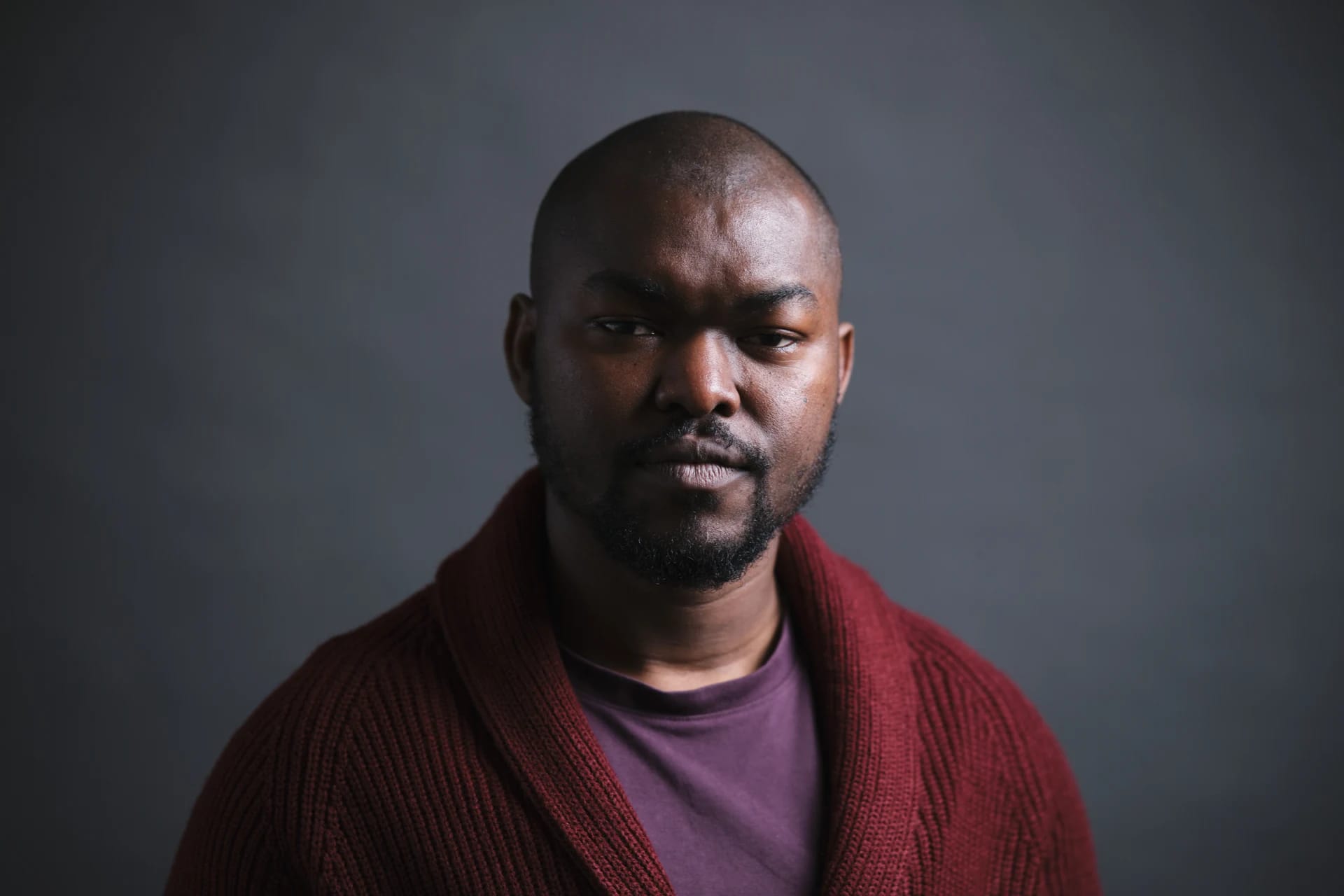
Babájídé látúnjí
Artist
Babájídé Ọlátúnjí (b. 1989) is a Nigerian-born, London-based, full-time studio artist, songwriter and singer working from studios in London and Ìbàdàn, Nigeria.
His work explores his Yorùbá history and philosophies with the perpetual goal of presenting these in a relatable global context. A self-taught painter with a background in Botany from Ọbáfẹ́mi Awólọ́wọ̀ University, Ilé-Ifẹ̀, Nigeria. He has spent more than a decade developing a distinctive practice inspired by art and antiquities original to South Western Nigeria, as well as the works of old masters from the early renaissance to the modern era. He combines careful observation with imagination, creating portraits and narrative paintings that draw on Yorùbá culture and mythologies while speaking to universal human questions.
His work has been exhibited internationally and is held in public and private collections in the United Kingdom, Europe, Africa, China and the United States, including the Bank of England Museum and the Mott-Warsh Collection. In 2017, he was selected for a curated section of the Royal Academy Summer Exhibition, and more recently his monumental History of the Yorùbás painting was unveiled at the John Randle Centre for Yorùbá Culture & History in Lagos. Throughout his career, Ọlátúnjí has approached painting as a way of preserving cultural memory while inviting conversations about the present.
Across projects such as Tribal Marks, Àrokò, The Book of Proverbs, History of the Yorùbás and The Cowrie Project, Ọlátúnjí has returned to the lives, beliefs, and traditions that have shaped Yorùbá society. Developing a multimedia practice, he executes these projects using Charcoal, Pastels, various types of paints, as well as ground cowrie shells as tools. His mastery of the chalk pastel medium is evident in the outsized hyperrealistic portraits that are a staple of his studio in Ibadan and London. He uses precision and history as tools to ask enduring questions about the vagaries of human life. Moreso, his paintings are results of extensive research built upon imagined figures, allowing individual stories to emerge as relatable, shared human experiences.
The Umberman marks a new chapter in Ọlátúnjí's practice. For the first time, he brings together painting and original music as equal parts of a single body of work, with each of the ten paintings paired with a corresponding composition. Together, they form the various stations on a certain umber-coloured man's journey in search of meaning in this ever changing world. The Umberman continues Ọlátúnjí's long-standing commitment to storytelling, inviting audiences not only to look at the work, but also to listen, reflect, and recognize something of themselves within it.
SEPT. 21–24, 2026.